The First Painting of the American Heritage Project
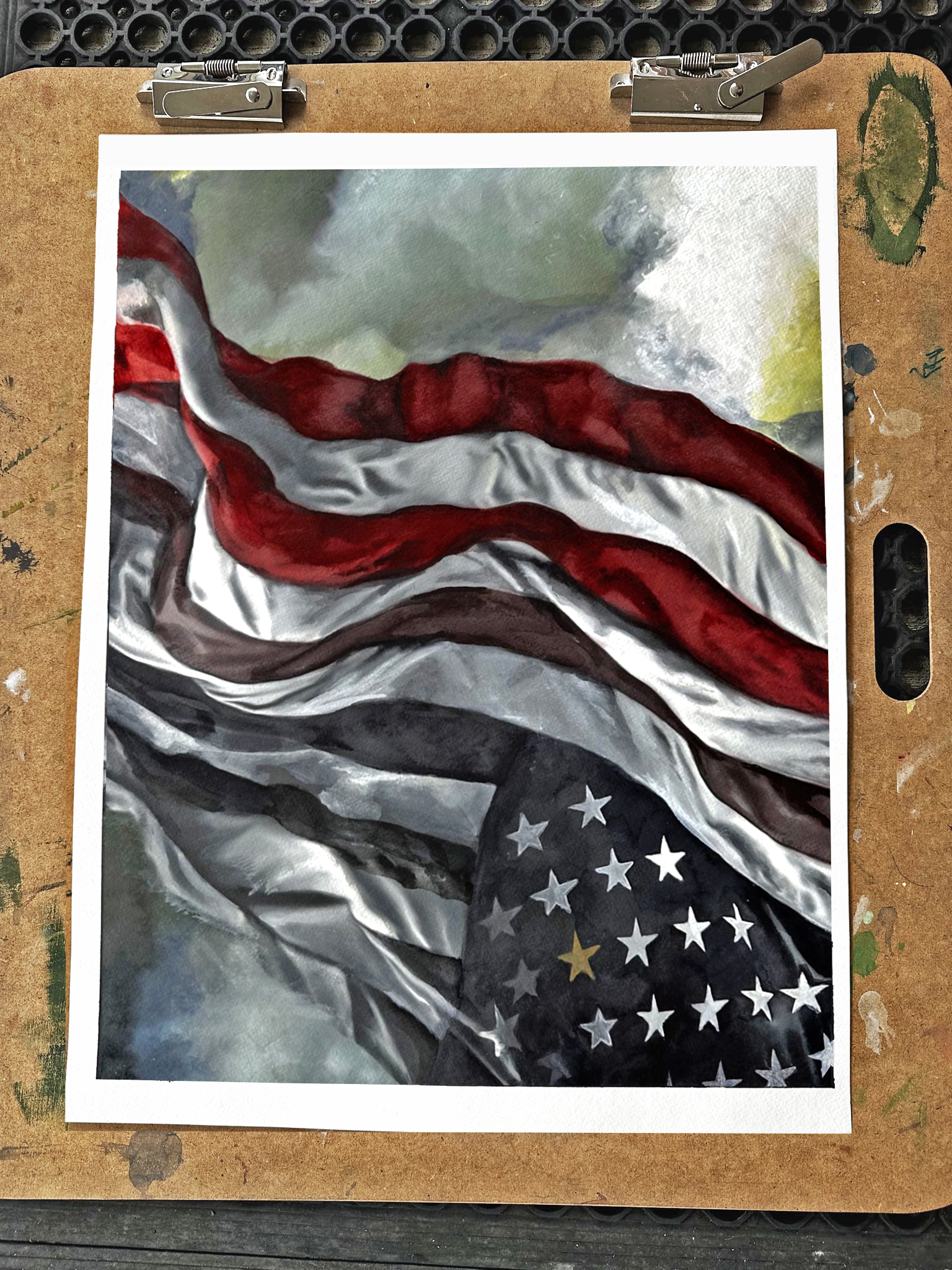
A flag painted with ash and charcoal Jordan made from the fire that burned her gallery on the Fourth of July. One side bright, one side faded; a study of resilience and erasure, made to hang in any orientation.
The Painting
The Flip captures the present dichotomy of viewpoints in our country, and it is profoundly personal. In its darker shadows, Jordan used paint she made herself from ash and charcoal collected from an arson fire that burned her gallery years ago on the Fourth of July. A bright American flag on one side and faded on the other, it speaks to both resilience and erasure.
Is the nation in descent, or in rebirth? At half-mast in mourning, tumbling through free fall, or flying at full force? The answers lie in the eyes of the viewer.
This painting can be viewed in any orientation. Turn it upside down, right side up, or to either side; each angle reframes the story. Inverted, the flag cries of distress. Upright, it ascends into the clouds. Tilt it, and the background shifts: smoke, fog, waves, or sky. Depending on the position, the stripes either bleed from red into black and white, thinning almost to disappearance, or move boldly from black and white into full, vibrant color. The back of the piece carries hanging hooks at both the top and the bottom, so it can be flipped and rehung in any orientation with ease.
Upright and inverted • ascent and distress
The American Heritage Project
The Flip is the first of the American Heritage paintings, a growing body of work commemorating the 250th anniversary of America: the events that marked the nation, the people who carried it, the machines that served it, and the land it stands on.
Many of these paintings reach back through our own connections: our Cherokee-Creek great-grandmother, who wrote poetry and songs; our friend Fred Oldfield, who came here by wagon train and showed us in his paintings; our grandfather, who laid tracks on the railroad at age fifteen; and the mechanics in Ely, Nevada, who kept the railcars alive. They honor the war hero who freed our family from Theresienstadt; Theodora, who risked her life hiding Jews, Allied pilots, and Italian prisoners in 1940s Netherlands; and the Victory Vertical pianos they owned.
But the paintings are only part of the picture. Each is made from the matter it depicts, with pigments of rock, clay, metal, and ash foraged from the places and people the work honors. Those materials transform the paintings into living archives, visually carrying each story.
Film • Jordan painting The Flip
News • The gallery fire
The Material
History rendered in its own matter.
In The Flip, that ground is ash and charcoal Jordan made from the fire that took the gallery. The painting holds the very thing it survived.
Acquire
Hand-finished archival giclées, each painted by hand so no two are alike, and numbered in a closed edition of 250. Each arrives framed and ready to hang, with a signed, numbered certificate and a video of Jordan painting that specific piece. The frame carries hangers on both ends, so The Flip can hang upright or inverted, just as the painting is meant to be shown. Museum-quality anti-reflective glass is available on request.
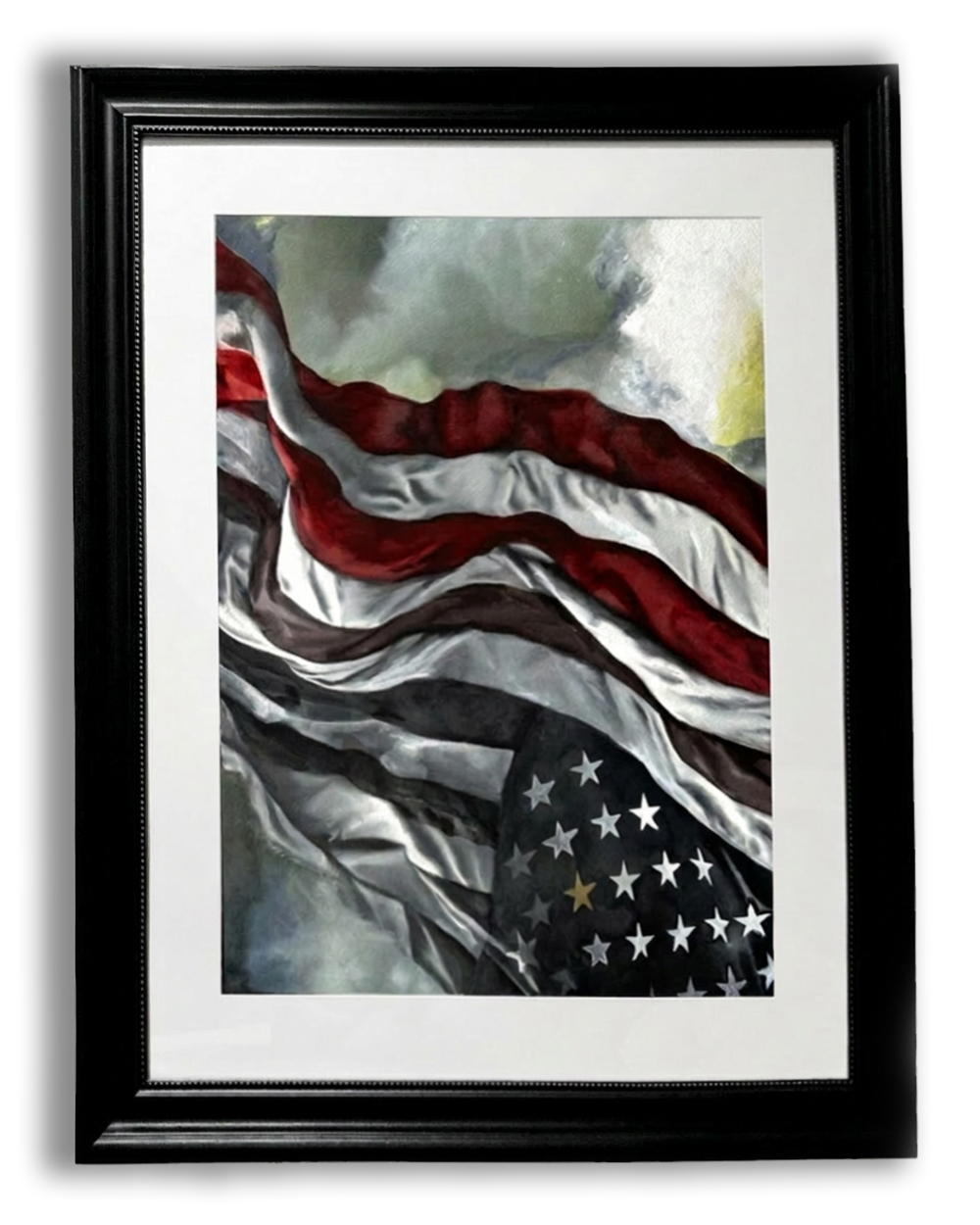
Each piece arrives framed and ready to hang, as shown.
$1,850
Ships framed • Shipping billed separately
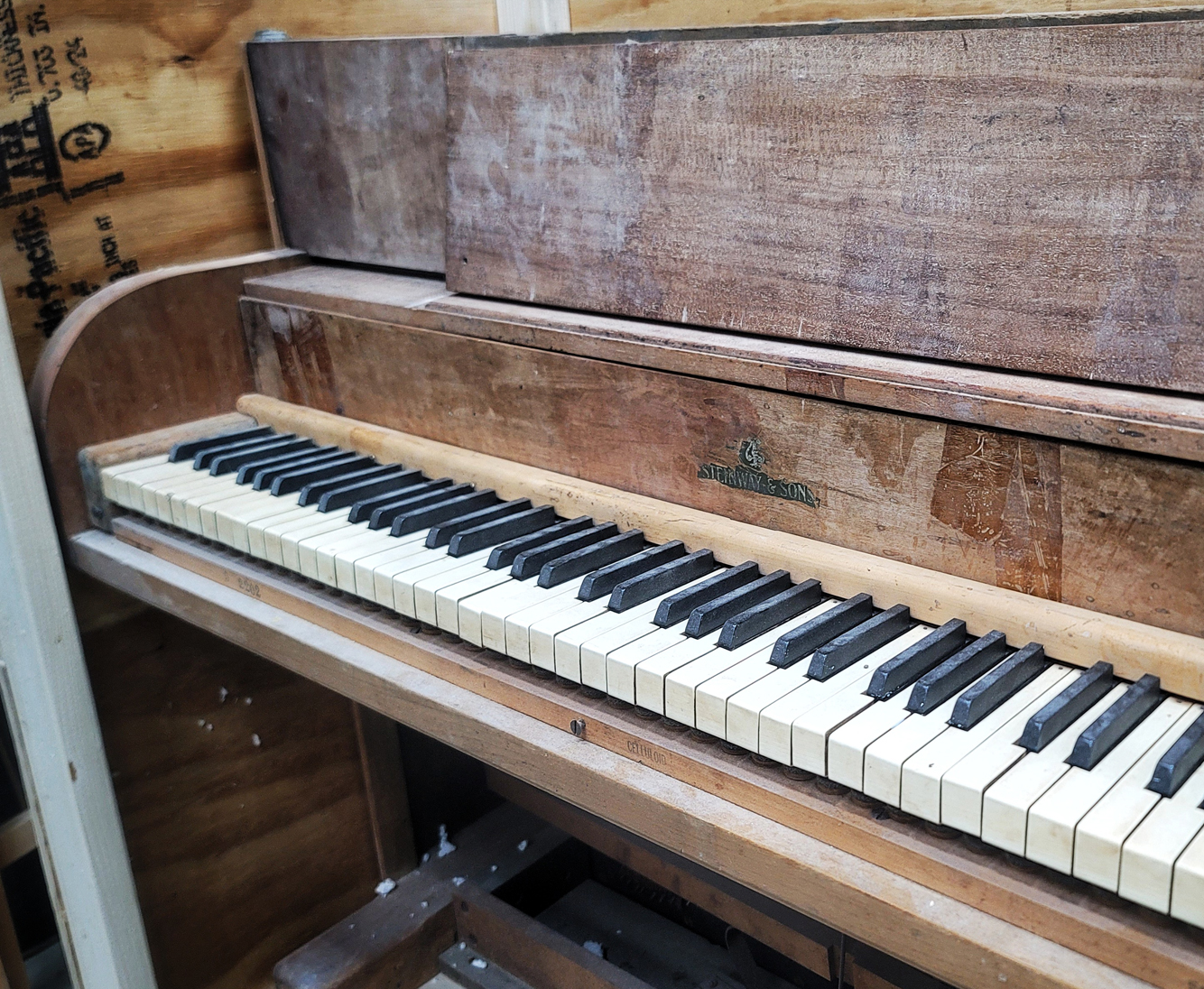
Acquire The FlipJordan A. Cook is a piano rebuilder, pianist, and watercolor artist whose work is rooted in the belief that beauty and meaning often emerge from what has been broken. She specializes in the restoration of WWII-era Steinway Victory Verticals, the compact pianos air-dropped by B-17 bombers into active war zones to boost troop morale, and is regarded as the foremost expert on the instrument.
Jordan sees these rare instruments as living archives, each carrying a story that deserves to be told to preserve and perpetuate its legacy. One such restoration was Colonel George Boucher's Victory Vertical, a piano he had begun repairing but never finished. In a collaboration across time, Jordan completed his unfinished work, honoring both the man and the music he left behind.
Jordan's journey into restoration began during a period of profound hearing loss, when she encountered a fire and water damaged 1925 Steinway L needing to regain its voice. Pressing a soot-covered key, she felt the piano's silent story, and her calling. That piano, named Arukah (Hebrew for restored to a better, though different, condition), became the namesake of her business, Arukah Piano.
In addition to restoration work, Jordan composes music and is an internationally exhibited artist working in gouache, watercolor, and mixed media made from her own foraged pigments, paint, and ink. Her paintings have been shown in historical and contemporary galleries around the world, including the Children's Holocaust Museum at Terezin, the Matterhorn in Switzerland, and at Maidan Nezalezhnosti in Kyiv, Ukraine.
Whether restoring a war-torn piano or painting with pigments made from earth and ash, Jordan engages in a quiet dialogue with time, creating works that bridge generations.
For Media
Journalists and press may download Jordan's biography and artist statement.
Follow Our Work
New restorations, paintings, and updates. We send them a few times a year.
Arukah Piano • Jordan A. Cook
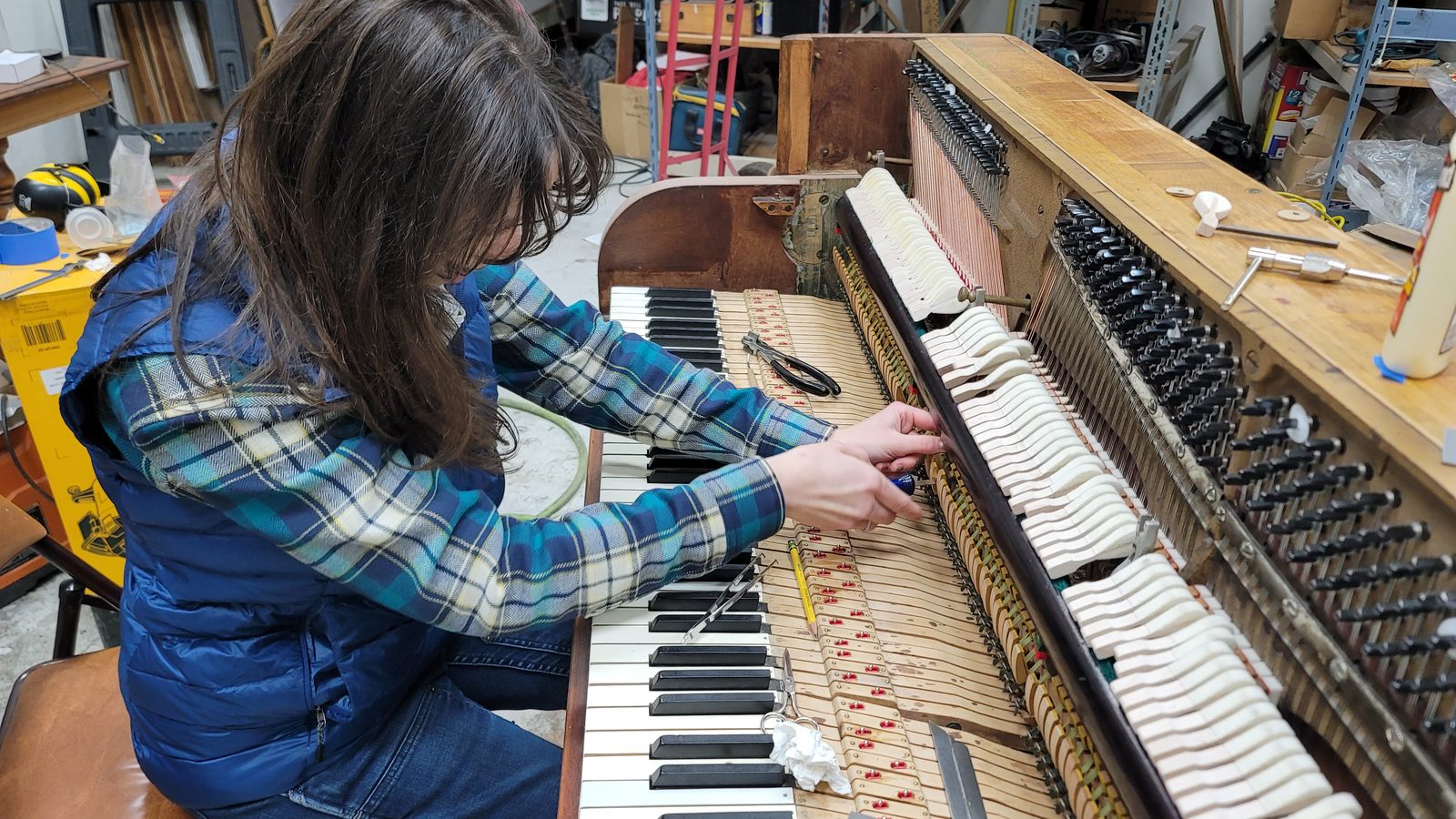
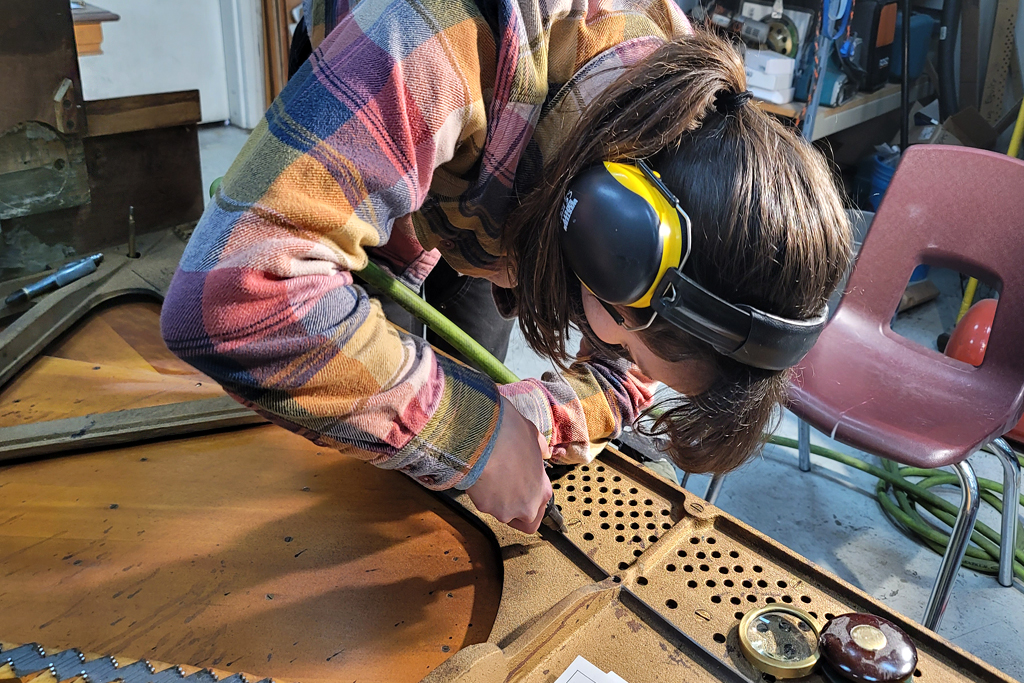
Shaping the V bar of a Steinway Victory Vertical
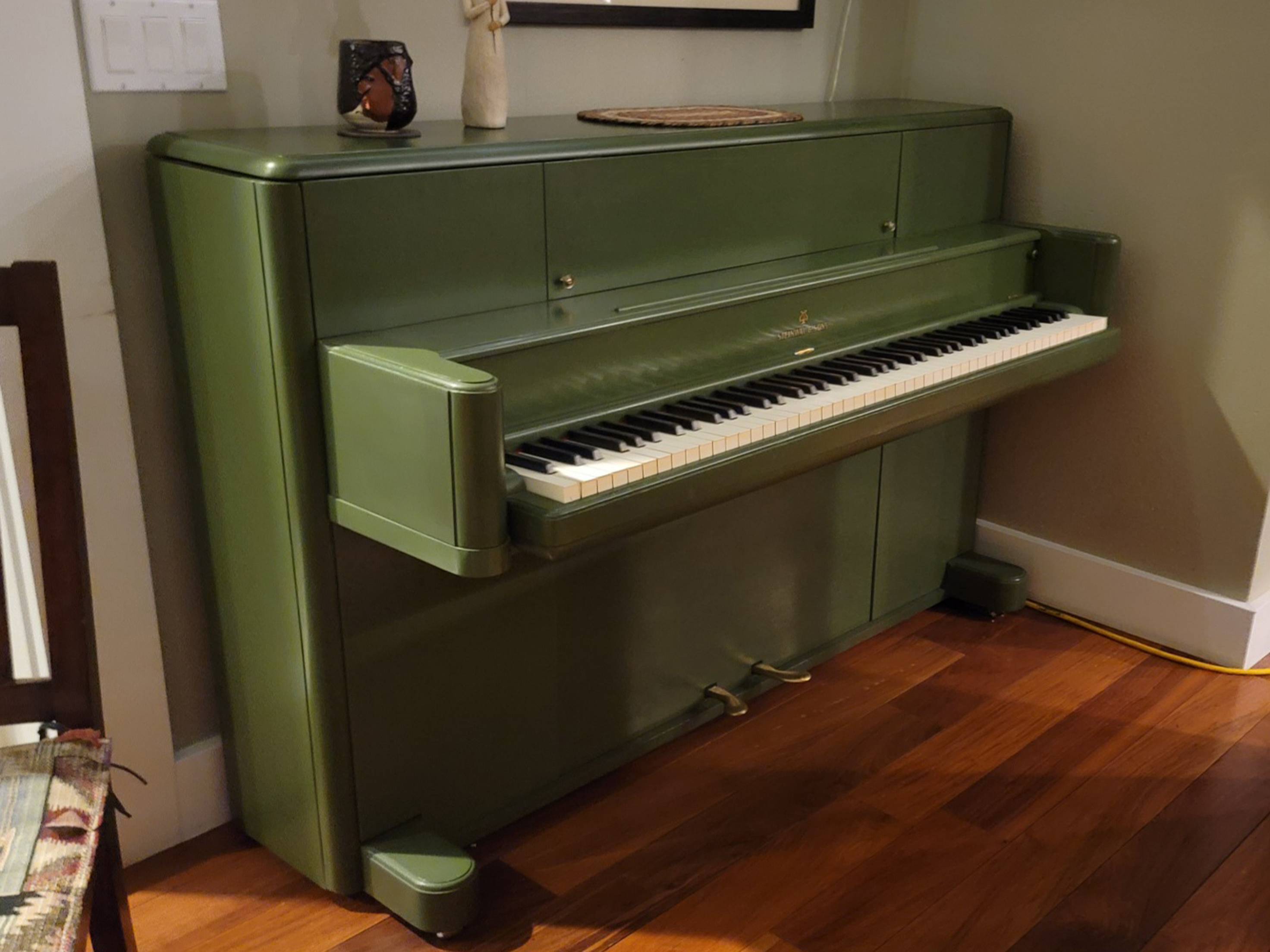
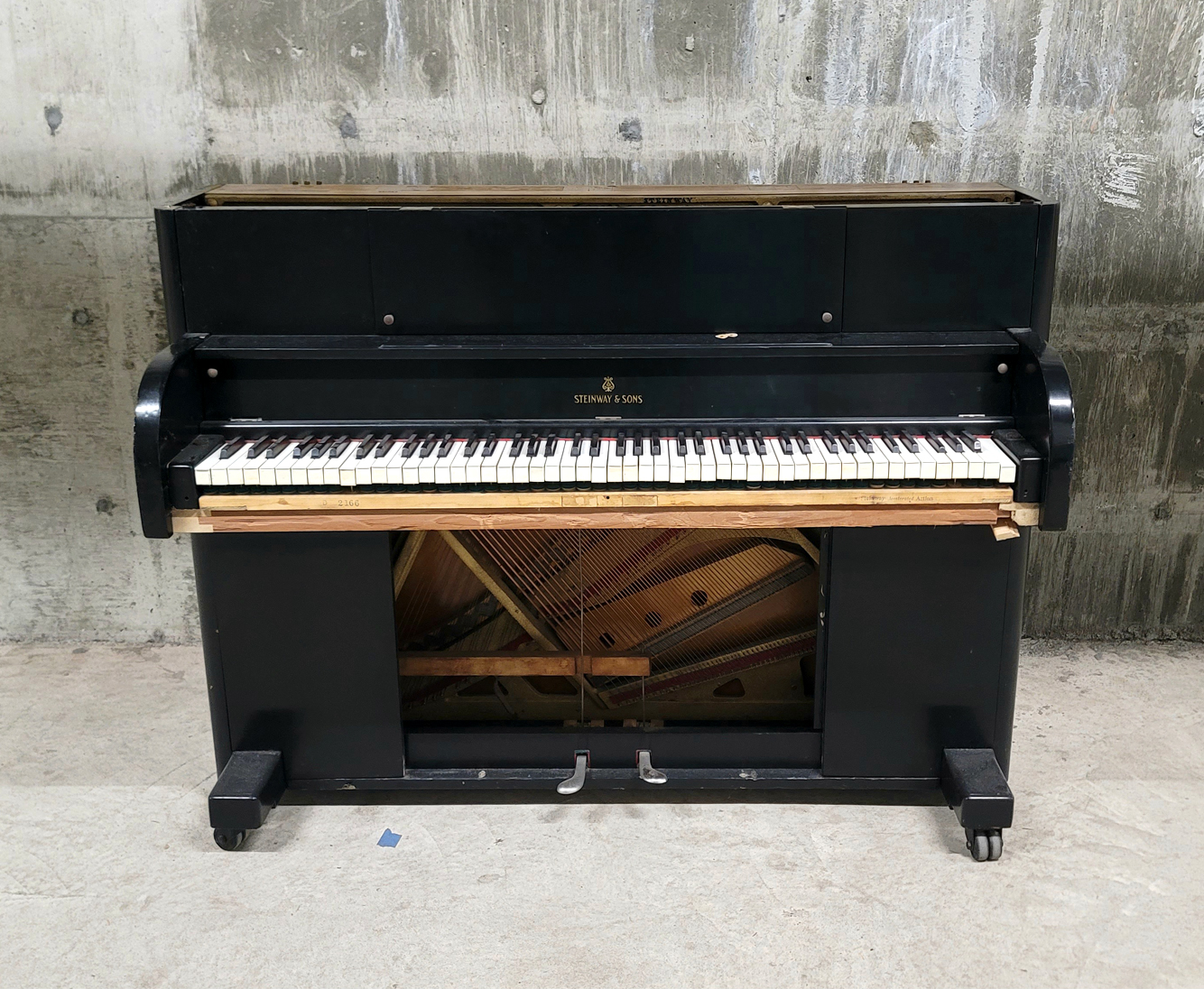
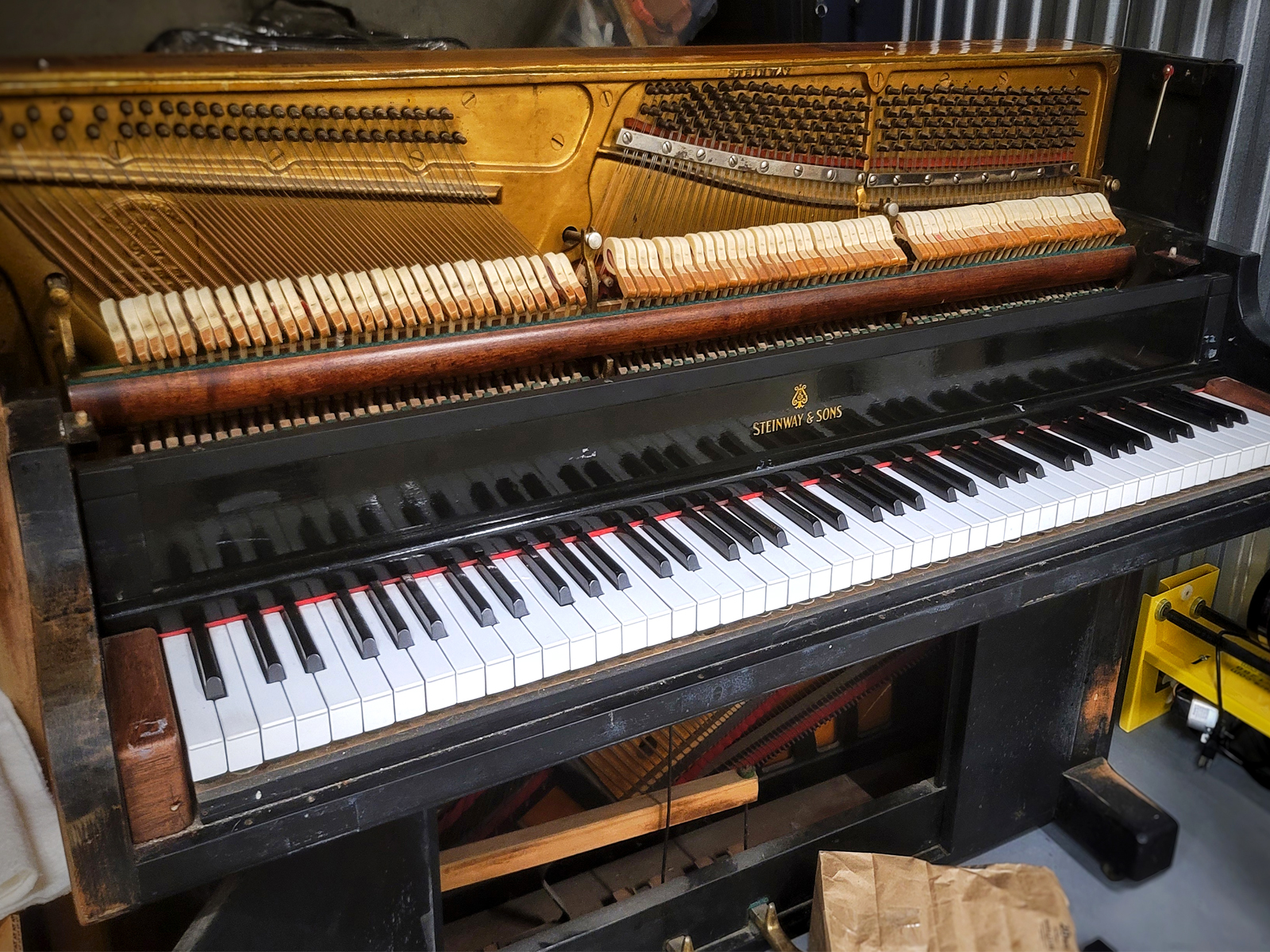
Steinway built the Victory Vertical small enough to fit through a B-17 hatch and rugged enough to survive what came after. They were shipped to active war zones, to the front lines and field hospitals, to chaplains conducting worship under fire and USO shows performed on makeshift stages. Each was finished in the color of its branch: olive drab for the Army, blue-gray for the Navy, teal-blue for the Marines. They were instruments of war and, for the same reason, instruments of home. A soldier who could sit down and play something familiar, or simply listen, was a soldier who remembered what he was fighting to return to. The women who built them had just left their own homes to take up places on the Steinway factory floor, doing work the men had set down when they shipped out. Home was built into these pianos by people in the middle of leaving it. The weight of that sits in every one.
What Jordan holds in her hands when she receives a Victory is a witness. It has been somewhere, and it shows. She reads each instrument the way a forensic examiner reads a scene: relentlessly, and with the patience of someone who knows that the details most people overlook are the ones that carry the story. Navy blue-gray paint on an olive drab Army model, applied in close quarters, as the archive dates confirm. A burn mark in a perfect circle where someone in New Guinea set a candle to dry the wood and left it too long. Water damage just visible under the flashlight. A hinge repaired in the field. Each one is a clue, and Jordan follows them.
She takes hours on details most rebuilders would simply replace. No part of the piano is wasted. The verdigris and colored felts become pigment for paint. Splintered or charred wood, when it cannot be saved, becomes charcoal for her art. She refuses to swap parts between Victories, insisting that each instrument's originals stay with it. Cracked pinblocks, overpainted decals, the quirky "fiddly-bits" as she calls them, all require patience and a familiarity that can run even between models of the same year and shipment date. She is an encyclopedia of Victory lore and ocular assessment, and when you watch her work, you notice the ease of slender fingers navigating tropicalized keys or iron-wound strings. She is a present-day picture of the women whose hands built these pianos on the Steinway floor.
Jordan documents her findings in shop note binders she carries to the studio each week. At home, the covers serve as makeshift palettes when she tests paint. The edges are worn and flayed, and the binders drop paper punchings when you lift them, second only to her pockets when she arrives home for the day. Inside are serial numbers, custom hybrid-wire scaling calculations, and hand-drawn three-dimensional sketches of ideas and improvements: a running record of instruments she is still learning from.
She is the foremost expert on Victory Verticals. She loves what they tell her about the people who played them, the workers who made them, and the people who found something in their music. She also brings each instrument past what the original design could do. "These were arguably pretty bad pianos as a whole," she says. "They were built under wartime constraints that left gaps in their elegance and sound, but with work, they sing better than they did when they were new, without cheating to do it." Cheating is her word for repairs made with modern parts when the originals can still be restored with care. They can.
The Collection
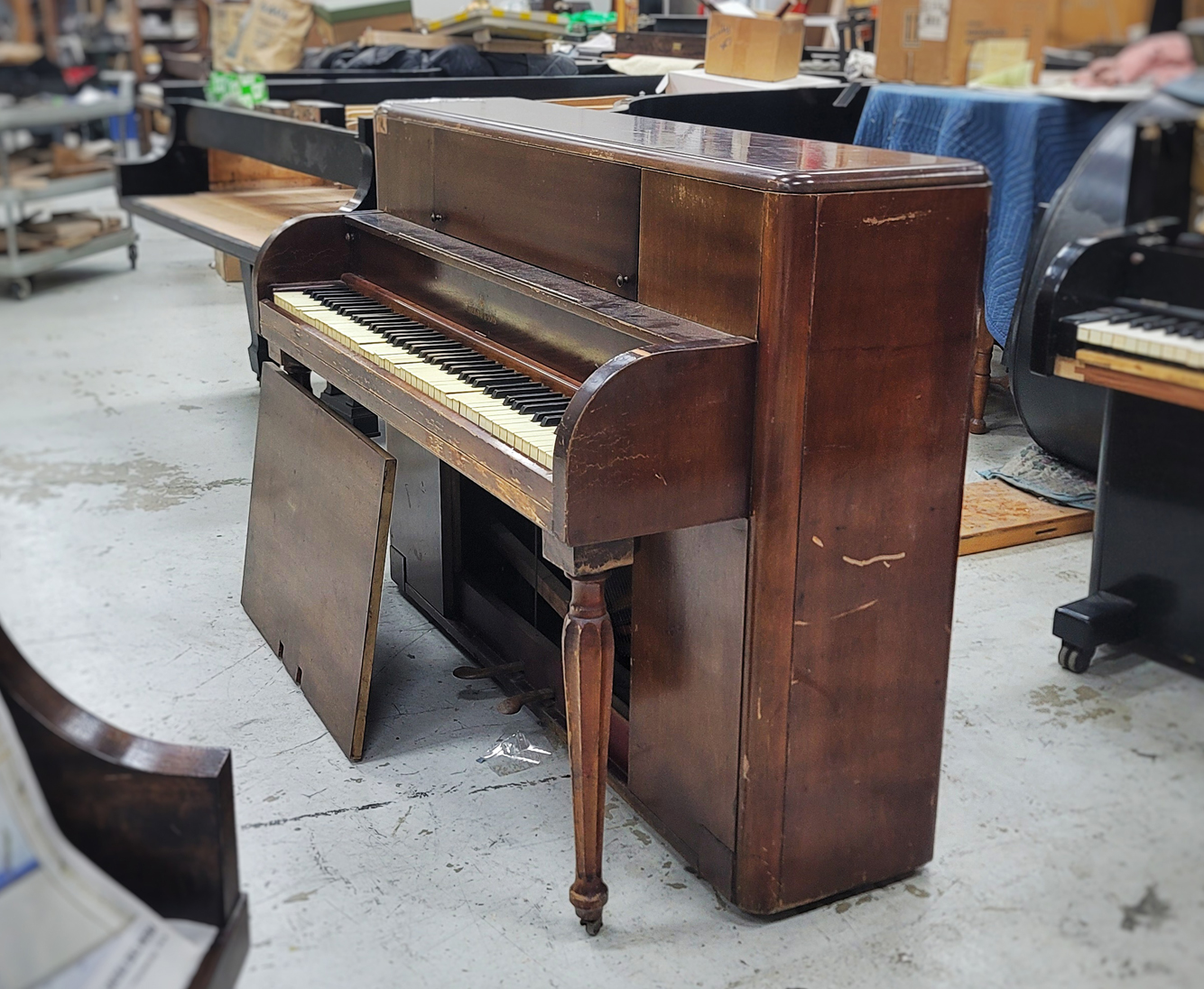
Each piano opens a different window on the war: the Pacific and New Guinea, Normandy and Korea, the Dutch resistance, the southern home front, and a story of survival. Open any one to read its history.
Regency Victory Vertical • January 26, 1943 • Olive Drab • Serial 314476 • Case U4436
Pacific Theater, New Guinea. Made in the Steinway factory on the General's sixty-third birthday.
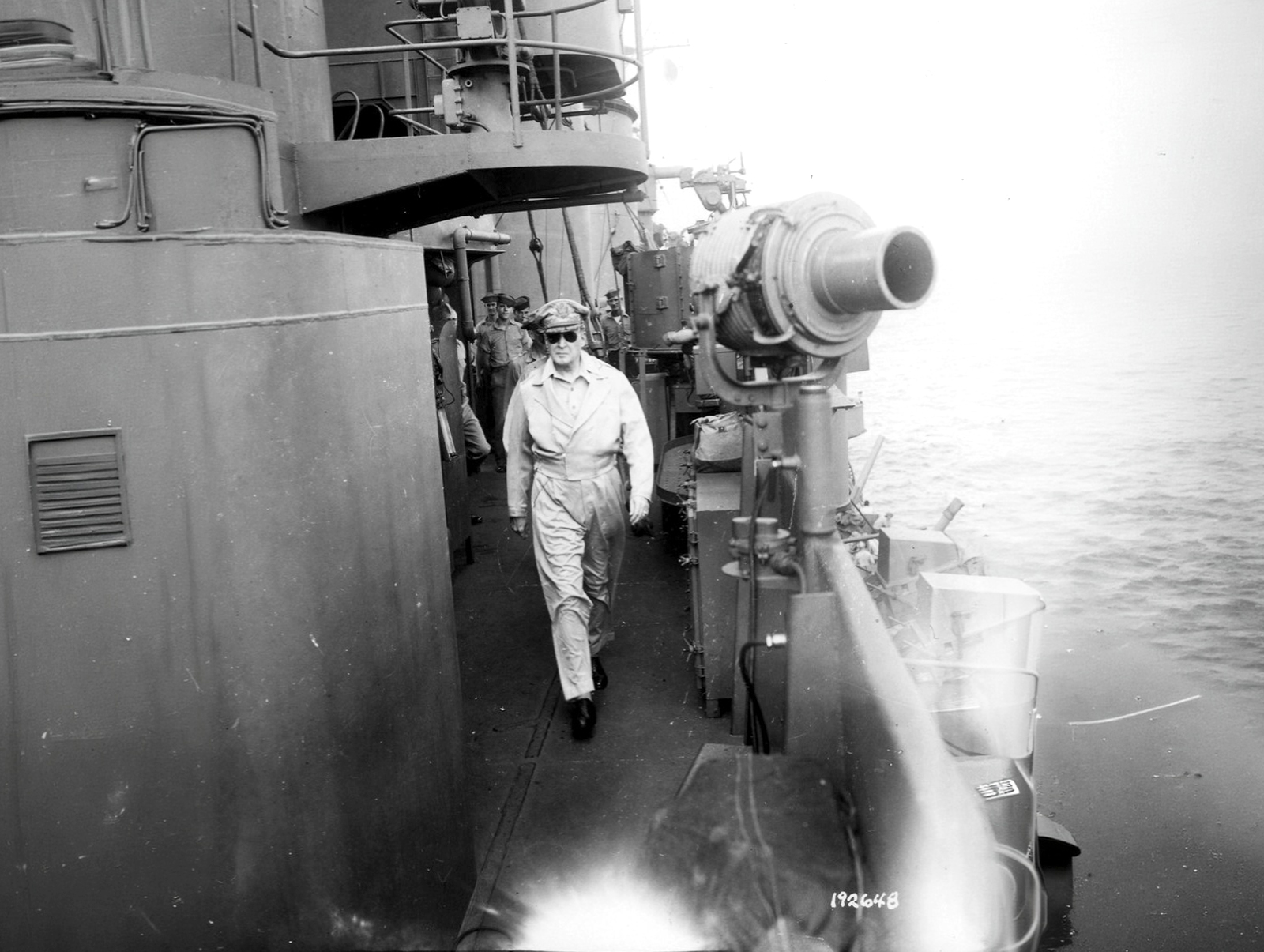
Listed in Steinway's archives as a Regency Victory Vertical, the prototype model that preceded the standard run, this piano was completed on January 26, 1943, General Douglas MacArthur's sixty-third birthday, in the week the Casablanca decisions committed the Allies to accepting only the unconditional surrender of the Axis. It was stationed at Hollandia in the Pacific Theater, in the officers' quarters known as "the mansion," during MacArthur's command.
General Douglas MacArthur walks to the flag bridge of the USS Nashville (CL-43) in Humboldt Bay off Hollandia, New Guinea, April 22, 1944. U.S. Army Signal Corps, photograph 192648.
MacArthur's son, Arthur MacArthur IV, a child prodigy who would go on to become a concert pianist, played this instrument as a boy. When the troops moved on, a woman was permitted to keep the piano. It made its way to a bistro in France, then to the workshop of Andrew Giller, a renowned piano rebuilder in the United Kingdom, before crossing the Atlantic by cargo container to its current home in Washington State. Its provenance is documented through original photographs, newspaper articles, and Steinway's own records.
Provenance is documented and updated as research continues.
Victory Vertical • August 24, 1949 • Army Drab • Serial 329236 • Case E1481
Normandy and Korea. Brought home from the front and stripped of its olive drab to never see war again.
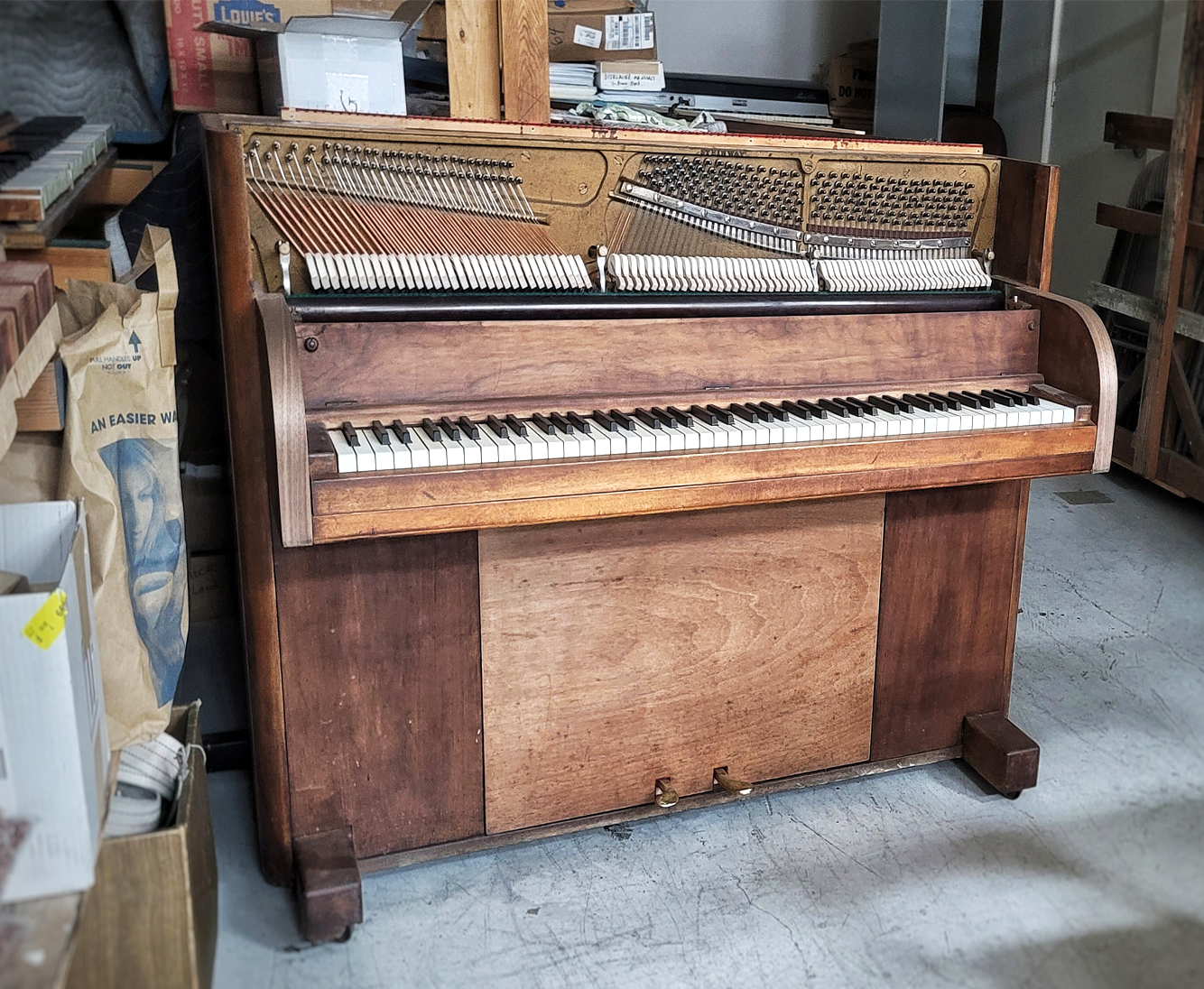
Among Jordan's most poignant restorations is the Victory Vertical once owned by Colonel George H. Boucher, a decorated war hero who served in both World War II and the Korean War. Colonel Boucher was part of the D-Day invasion in Europe and helped clear out Nazi work and death camps.
He was awarded fourteen medals and commendations, several Presidential citations, and held the distinction of having engaged the enemy in combat 94.4% of the time on the front line. Both of his hands were wounded by shrapnel; he refused medical assistance and declined a Purple Heart, feeling he deserved no special recognition for doing his job. He also served as chaplain, conducting worship and prayer on the front lines.
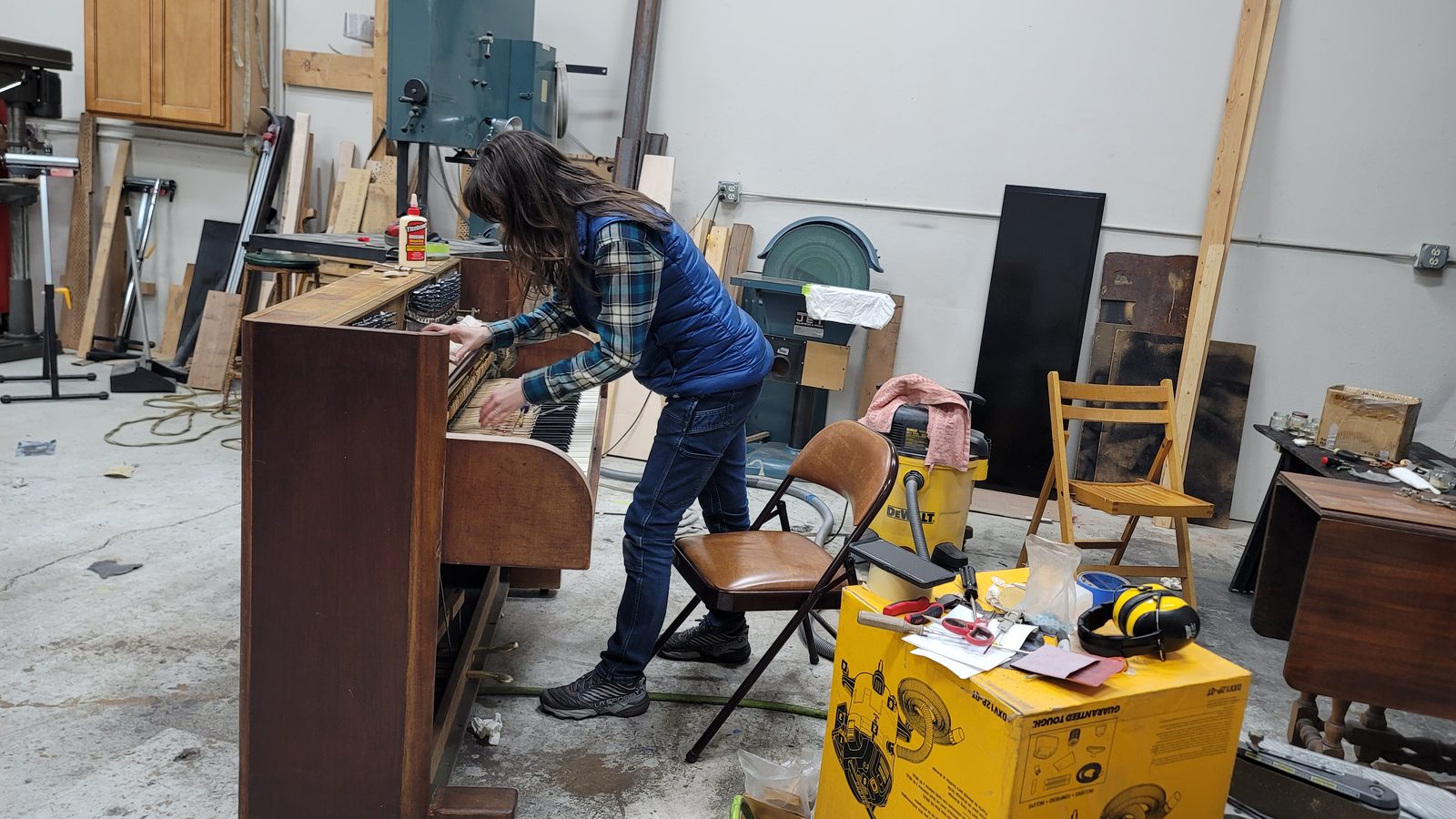
Jordan at work on Colonel Boucher's Victory Vertical • Arukah Piano
Colonel Boucher brought this Victory Vertical home from Normandy and stripped the olive drab paint from it as a statement that it would never see war again, an act known as decommissioning. Jordan acquired the piano from Florida and brought it home to Washington for rebuilding. Over the following months, she uncovered traces of the Colonel's own handiwork: innovative repairs and design modifications he had begun and never finished. In a collaboration across time, she completed his unfinished work to honor the man and his piano, and kept the wood bare, exactly as he left it. Her restoration is a playable, living archive she still calls "his" piano, one she has the privilege of stewarding. Colonel Boucher passed away in 2018 at the age of 103.
Detail work at the keys • Arukah Piano
Provenance is documented and updated as research continues.
Victory Vertical • 1944 • Serial 315638
The Dutch resistance. Recognized by General Eisenhower and Yad Vashem.
Theodora is named for Theodora Van Doorninck Cole, whose family was part of the Dutch resistance during World War II. They sheltered downed Allied pilots, hid Jewish families, and protected Italian prisoners of war, at extraordinary personal risk.
Their bravery was formally recognized by General Eisenhower and by Yad Vashem, Israel's Holocaust remembrance authority. This is her piano, carried forward by the same hands that rebuilt Colonel Boucher's, a tribute to a family who chose courage when it cost them everything to do so. Its full provenance is still being assembled.
Provenance is documented and updated as research continues.
Victory Vertical • November 3, 1948 • Army Drab • Serial 327088 • Case D2162
The southern home front. A North Carolina congregation, then a church basement for decades.
Bishop carried music to a North Carolina congregation through the war years, the heartbeat of a Black church and the gatherings it held. When the war ended, the piano fell silent. It rested in a church basement for decades, unseen and nearly forgotten, until it surfaced again for this restoration.
It is dated November 3, 1948, the morning the nation woke to the infamous and mistaken headline, "Dewey Defeats Truman."
Provenance is documented and updated as research continues.
Victory Vertical • December 7, 1945 • Army Drab • Serial 318438 • Case A2371
A story of survival. Three Gulf Coast hurricanes weathered at Sarasota.
Charley Helene Milton is named for the three storms it outlived: Hurricane Charley in 2004, then Helene and Milton in the autumn of 2024, all along the same Florida coast at Sarasota. Milton came ashore at Siesta Key on October 9, the first storm to make landfall in Sarasota County since 1944. As its eye crossed overhead, the owner watched on a webcam while trees and debris flew through the yard; inside that ring the house stood completely still and untouched. The piano came through whole.
Left to right: Hurricane Charley (2004), Hurricane Helene (2024), Hurricane Milton (2024). Satellite imagery courtesy NOAA/NASA, public domain.
It was completed on December 7, 1945, the fourth anniversary of Pearl Harbor and the first observed in peacetime, built in a season that understood survival.
Provenance is documented and updated as research continues.
Victory Vertical • November 24, 1948 • Olive Drab • Serial 327333 • Case D2170
Shipped out of New York, returning to a New York artist loft once restored. Its full story is coming soon.
Liberto shipped out of New York and is returning to a New York artist loft once restored. Its full history is being assembled.
Provenance is documented and updated as research continues.
In the Workshop
Film • At work on a Victory Vertical
The Rebuilder
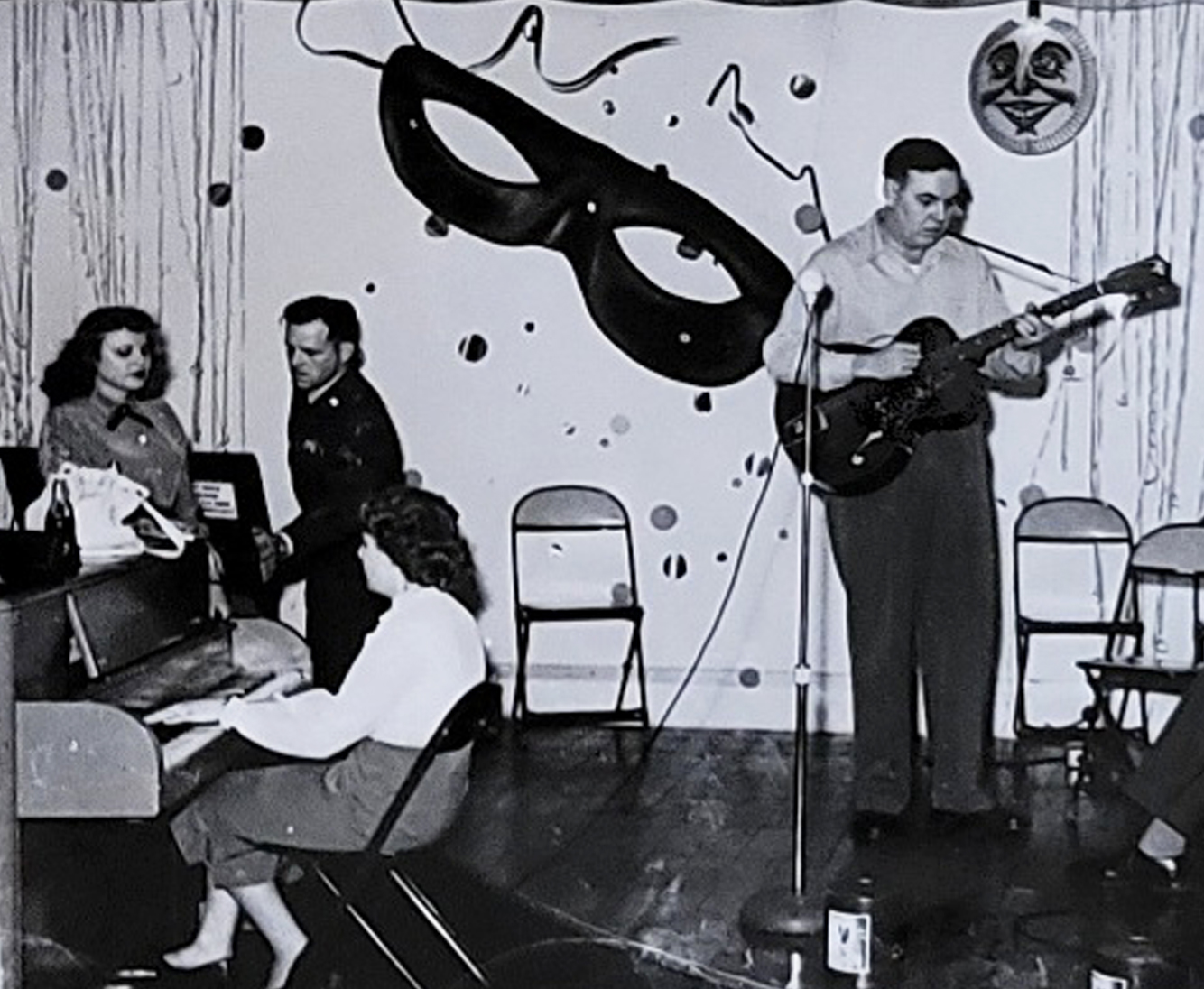
Peggy, Jordan's great-grandmother, playing a Victory Vertical at a USO during the war
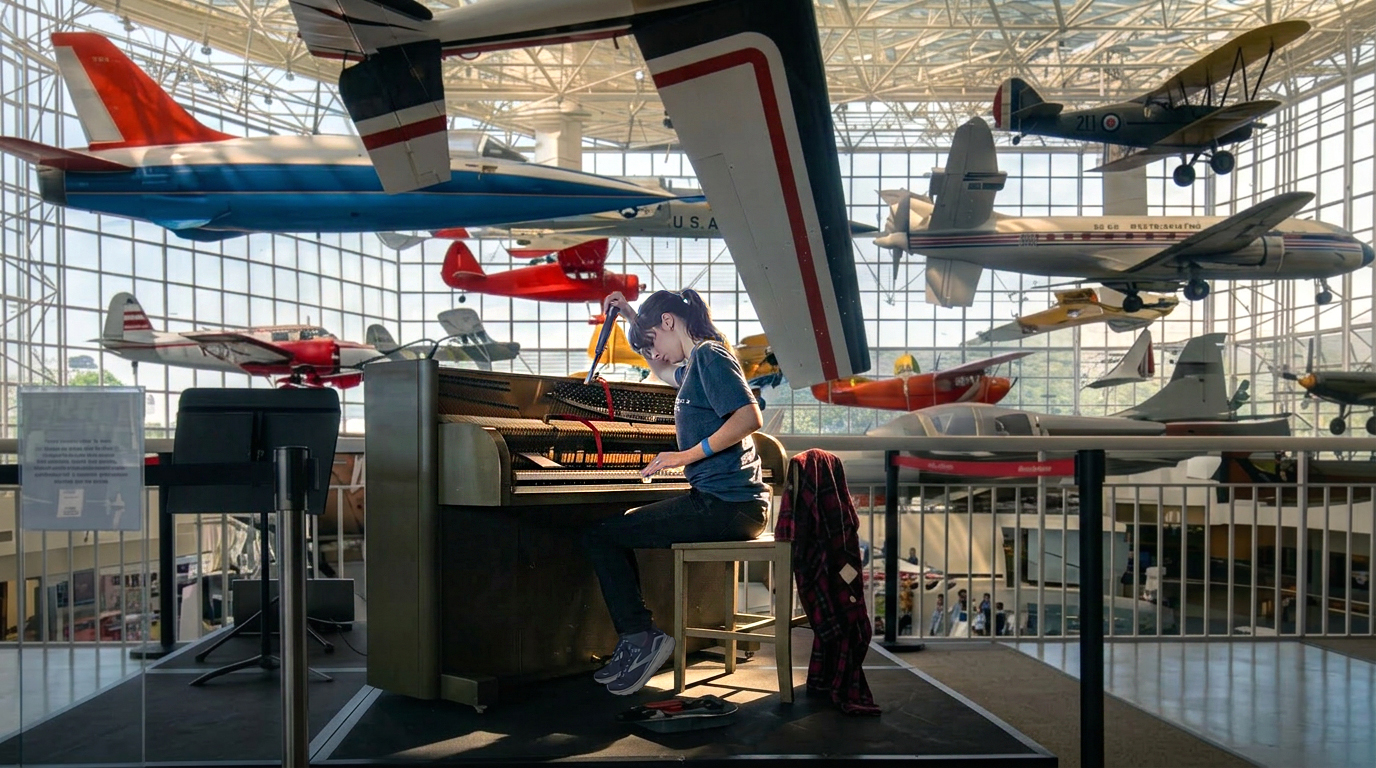
There is no more fitting place to see one rebuilt than the Museum of Flight in Seattle, among the aircraft that once carried them. Jordan's work there brings the story full circle: an instrument designed to travel by air, returned to voice in the company of the machines that delivered it to the front.
At the Museum of Flight, Seattle, working on a Victory Vertical
Do you have a Victory Vertical? Jordan would love to meet it. Send her photos, the serial number, and whatever story you know. We've built a database of every Victory that's surfaced, and each one adds to the historical record. Reach out and introduce yourself.
Acquire
A small number of restored Victory Verticals become available to collectors, museums, and institutions, each rebuilt by hand and carried forward with its documented history. Tell us the instrument or the story that draws you. Jordan answers personally and is available for a phone consultation.
Inquire About a Victory